In shortAt the spring itself, inside the mountain, the figure reported is about 37 °C, the hottest reading on site.
The official pools page lists the cave, the tunnel and the terrace pools at 36–38 °C. The river is the one spot the operator numbers twice: 34–36 °C on its English page, 36–38 °C on its Spanish one. Past the grottoes the flow meets cold river water and goes tepid.
36–38 °Ccave, tunnel, terrace pools
34–36 °Criver, English page
about 37 °Cwater at the source
1,280 maltitude at the pools
How hot is Tolantongo water in the cave, the pools and the river?
The operator publishes the Tolantongo water temperature in three places, and the three do not agree. The official pools page puts the cave, the tunnel and the terrace pools at 36–38 °C, close enough to body heat that people lose half an hour without noticing.
On the river the park contradicts itself. The English river page gives 34–36 °C, the Spanish one 36–38 °C for the same stretch. Both are the operator's text, so treat the figures as a range and read whatever is posted at the water on the day.
Inside the mountain the flow is reported at about 37 °C, the warmest water on site, and it holds that heat only while it stays enclosed in rock. Once it leaves the grottoes and meets the cold river it drops to tepid. That is why the same water can feel fierce on the terraces above and merely pleasant down in the channel, and why both river figures are defensible.
Four things decide how hot a given spot feels: whether the air above it is enclosed or open, how far the water has travelled from the spring, how much cold river water has joined it on the way, and the air temperature outside. The last one surprises people. At Ixmiquilpan, the nearest town, overnight lows average about 8 °C in January and December and about 16 °C in June, so a January dawn makes 37 °C water feel far hotter than the same pool on an afternoon in May.
| Spot | Published temperature | Open hours | What to expect |
|---|
| Main grotto chamber | 36–38 °C (official pools page) | 8:00–17:00 | Enclosed chamber about half the size of a tennis court, ceiling up to ten metres, hot water showering down off the rock; the strongest heat anywhere on site |
|---|
| Tunnel | 36–38 °C (official pools page) | 8:00–17:00 | Narrow, humid and dark; bring a headlamp, and the heat builds the further in you walk |
|---|
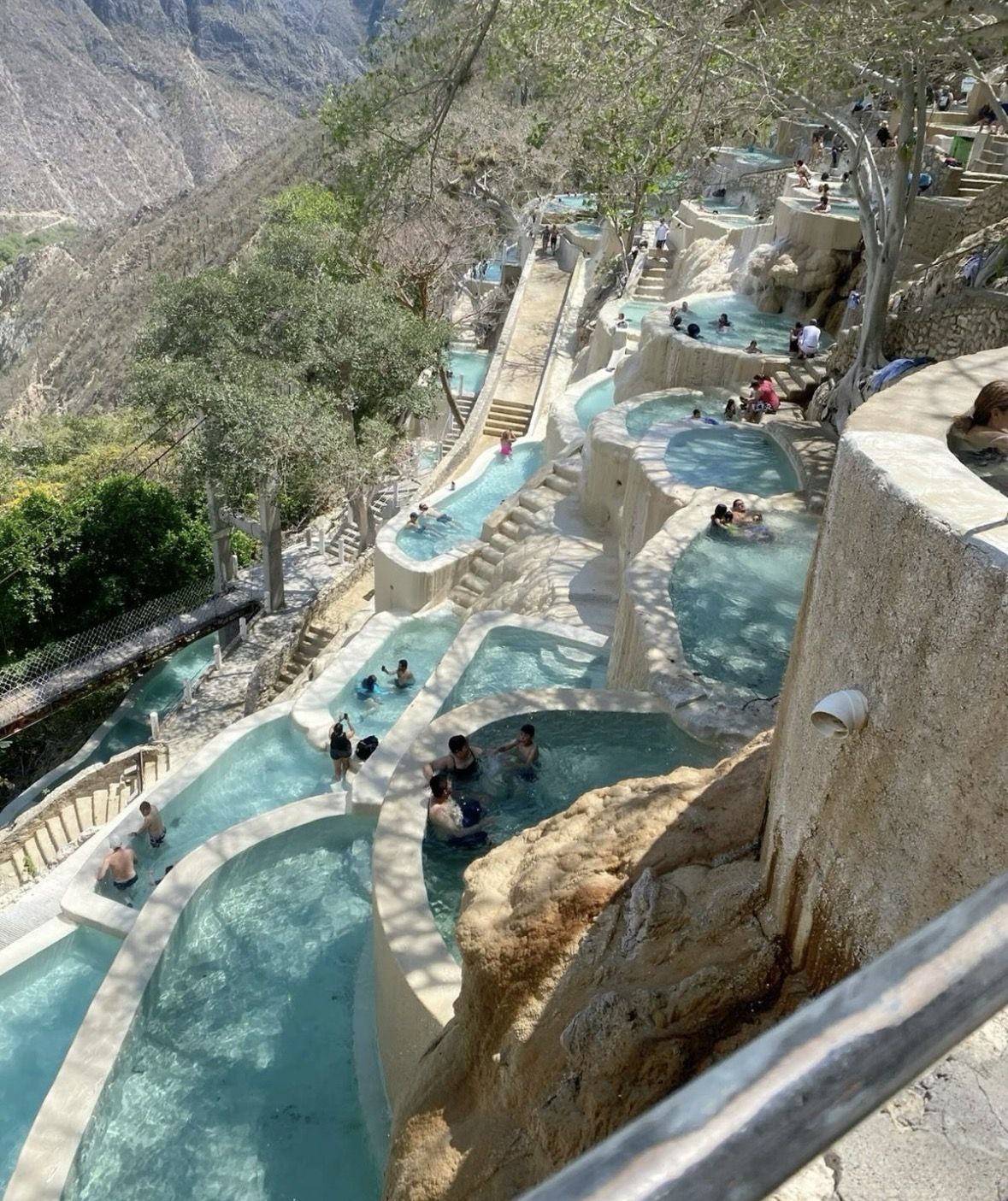
| Terrace pools (about 40) | 36–38 °C (official pools page) | 8:00–17:00, with some pools open to 21:00 | Every pool is fed independently from the spring network, so two side by side can feel different; the whole network is drained and cleaned every other day |
|---|
| Swimming pools | No figure published by the operator | 8:00–17:00 | The official pools page warns that some are deep and need the ability to swim, and that children must be watched at all times |
|---|
| Thermal river | 34–36 °C on the English page, 36–38 °C on the Spanish page | 8:00–21:00 | Shallow, in the park's own description; coolest where cold water joins the thermal flow, and the only water attraction open into the evening |
|---|
The full day, with the kit for the grotto
Prices start at $134 for a 14 to 16 hour day, rated 4.8 from 1,569 reviews, with private air-conditioned transport. The loan backpack covers most of what the 36–38 °C cave and the cliff terraces actually ask you to carry: headlamp, sport towel, waterproof phone cover, sunscreen.
★ 4.8/5 · 1,569 reviews
Why is the water blue at Tolantongo?
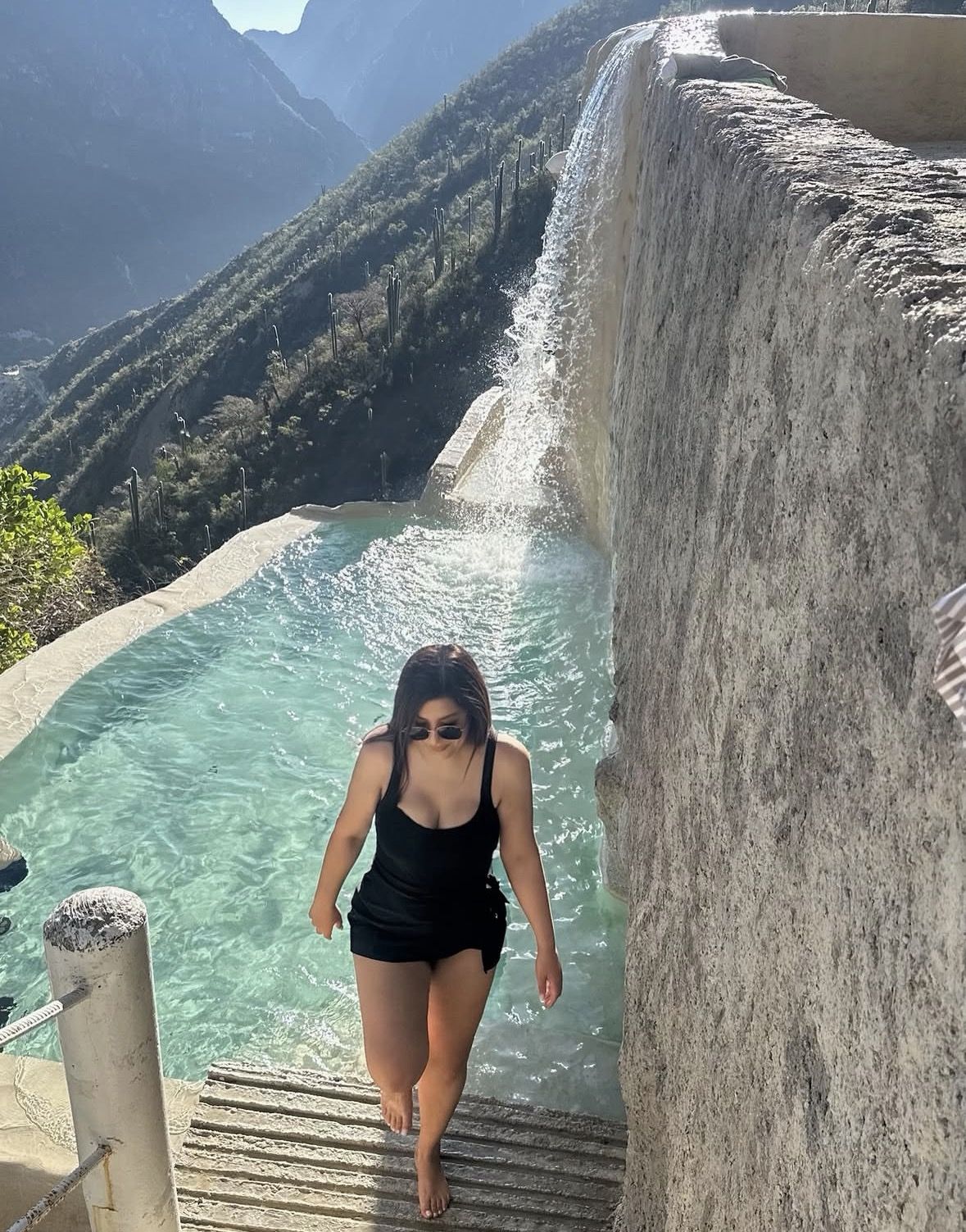
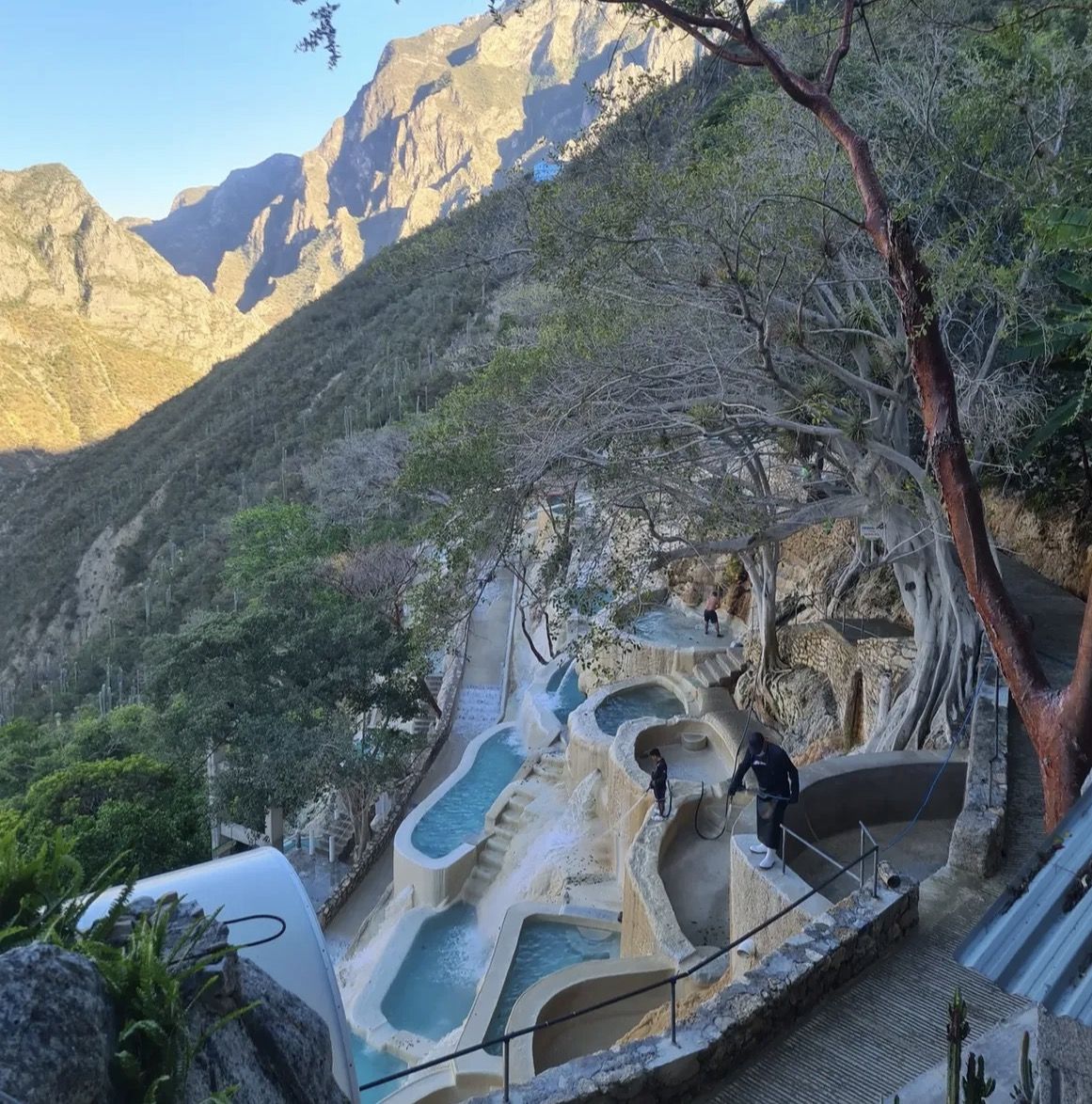
Mineral content is the explanation the published sources give: the spring water is high in calcium and magnesium, and that dissolved load produces the turquoise cast. Light entering a pool scatters off the fine minerals and off the pale limestone the canyon is cut into, and what comes back out is the blue-green that shows up in every photograph of the terraces.
Nobody has published the numbers. There is no laboratory analysis of the Tolantongo water giving milligrams per litre of calcium or magnesium, from the operator or from any Mexican agency, and no study of the colour mechanism at this site. Calcium and magnesium are the accepted explanation; no one has measured it here.
Light does the rest of the work. The pools sit at 1,280 metres on the floor of a box canyon with walls rising as much as 500 metres, so direct sun reaches the terraces for only part of the day. The turquoise reads strongest when the sun is actually on the water, and on the cliff terraces that means mid-morning onwards.
Cleaning matters too. The terrace network is drained and refilled every other day, and a pool filled an hour ago is visibly clearer than a busy one at four in the afternoon.
Where the heat comes from
Nothing here is heated by machinery. The Mezquital Valley sits between about 1,700 and 2,100 metres inside the Trans-Mexican Volcanic Belt, and three overlapping aquifers have been identified beneath it. The deepest of them lies in Cretaceous limestones, and that is the reservoir feeding the thermal springs across the region.
The canyon is cut mainly into Upper Cretaceous limestone interbedded with shale, dipping at 30 degrees or more, with early Tertiary piedmont deposits on top carrying limestone blocks up to three metres across. Water circulating deep in that limestone takes on heat and picks up the calcium and magnesium it later leaves around the rims of the pools.
Follow the hot water back and it all arrives from one place: a cave near the head of the canyon, the biggest of the outlets. Pipes carry it down from there into the dozens of soaking pools stepping down the hillside, which is why the terraces hold a steady temperature while the river, open to everything that drains into it, does not.
The canyon itself loses more than a kilometre of height along its course, from around 2,300 metres where it begins north-west of Cardonal to about 1,150 metres near Itztacapa, so the thermal water surfaces well down that profile. In La Gloria, the separately run park next door, the water is reported to emerge at 38 °C, which tells you how consistent the reservoir is across the valley.
When the turquoise turns brown
Heavy mountain rain changes the river within hours. The level comes up fast, the colour goes with it, and the park moves people: July 2021 is the episode on record, when campers were shifted to higher ground and the grottoes were cordoned off. During the rains the instruction is short. Stay out of the river, and do whatever the security staff tell you.
On the operator's own reckoning the wet weeks fall between mid-June and mid-July, and for that stretch it tells campers to keep their tents away from the riverbank. At Ixmiquilpan the wet season is longer, about 4.4 months from 1 June to 12 October, with monthly rainfall around 137 mm in September against roughly 9 mm in December.
A brown river does not write off the day. The terraces draw from the spring network rather than the river channel, so they keep their colour while the water below is carrying silt, and the cave is unaffected as well. If you are picking dates purely for the photographs, mid-October to early December and February to April are the safer windows.
The park runs 365 days a year, 7 am to 8 pm, with no closed season, so rain decides which water you find rather than whether you can bathe.
How long to stay in, and what to take off first
At 36–38 °C you are sitting in water close to your own body heat, which is why nobody keeps track of time on the terraces. Get out before you stop feeling the warmth, sit on the edge, cool down, then go back in. The grotto needs more discipline: the chamber is enclosed, the air is saturated and hot water falls on you straight off the rock, so several short visits with breaks outside work better than one long session.
Drink between pools rather than only at lunch. The restaurant and the grocery store open 8:00 to 22:00 and take cash, like everything else inside the park. There is a basic medical service on site, plus toilets, showers and changing rooms.
Mineral water is unkind to metal and to pale fabric. Take off silver, plated jewellery and anything you would regret seeing dulled, and expect a chalky film on light swimwear that rinses out more easily the same day than a week later. A locker costs MXN 150 with MXN 50 handed back when you return the key, and the locker service runs 8:00 to 17:00 only, so plan the end of your day around that.
Rules worth knowing before you change: swimwear is required for the grotto, the tunnel and the river, babies go in swim diapers only, and comfortable footwear is part of the requirement. Depth is not uniform in the swimming pools, and the official page says some of them call for the ability to swim. Children have to be supervised throughout, and the official waterfalls page tells visitors plainly not to try climbing the falls.
- Proper swimwear and shoes you can walk in for the cave, tunnel and river, with babies in swim diapers only
- Jewellery and watches off before the first pool
- A headlamp for the tunnel, and a waterproof phone cover if you want pictures in the grotto
- Cash for everything, locker deposit included, with no cash machine nearer than Ixmiquilpan
- Follow the security staff, and stay out of the river after heavy rain
The order to bathe in, if you have one day
Closing times set the order. At 17:00 you lose the grotto, the tunnel, the waterfalls and the swimming pools, while the thermal river and part of the terrace bank keep going until 21:00. Everything on the 17:00 list belongs in the first half of your day.
Start with the cave and the tunnel at 8:00, when they open, the chambers are still quiet and you have the energy for that much heat. The swimming pools suit the middle of the day. Leave the cliff terraces and the river for late afternoon and evening, once the day visitors are driving out and the air has cooled enough to make 36–38 °C water feel like a reward. Working through that order means crossing between sections, and the internal shuttle charges MXN 15–20 a head, or MXN 150 per leg if you want it to yourselves, up to five people.
On a day trip the sequence matters more, because the clock is tighter. The whole point of the 4:30 am meeting time on the Early & Express Tolantongo Hot Springs is to put you at the grotto as it opens: 13 hours, from $137, rated 4.9 from 679 reviews, park tickets and an air-conditioned vehicle included. The Full-Day Tour Exploring the Waters of Tolantongo is 14 to 16 hours from $134, rated 4.8 from 1,569 reviews, and lends you the headlamp, sport towel and waterproof phone cover that the cave and the terraces ask for. For someone walking the sections with you, the Tolantongo Caves Hot Springs & Waterfalls Small Group Tour meets downtown at 5:30 am, lasts 14 hours, starts at $132 and is rated 4.6 from 351 reviews, with a professional guide, caves entrance and round-trip transport in the price.
All three are run by licensed operators, and each gives a full refund if you cancel at least 24 hours before departure, which helps when the forecast turns.
Questions people ask
Is the water warm enough to visit in January?
Yes. The heat is geothermal, so it ignores the seasons: the source water is reported at about 37 °C and the pools at 36–38 °C all year. The air is what changes. Overnight lows at Ixmiquilpan average around 8 °C in January, the coldest month, which sharpens the contrast when you get in.
Why does one terrace pool feel hotter than the one next to it?
Each of the roughly 40 terrace pools is fed independently from the spring network, through pipes running from the cave near the head of the canyon. Distance from the source, how recently a pool was refilled and how exposed it is to the canyon air all shift how it feels. Then there is the cleaning cycle: every other day the pools are emptied and refilled, and one just topped up behaves differently from one that has sat all afternoon.
How does Tolantongo compare with other thermal baths in the region?
On published figures Tolantongo sits at the warm end. The cave, tunnel and terrace pools are given as 36–38 °C, and La Gloria, the separately run park next door, reports its water emerging at 38 °C. For comparison, the springs at Hotel Balneario Tzindejéh in Tasquillo are described as a constant 31 °C, and the pools at Xhandos Ajacuba average 36 °C.
Will minerals in the water damage my swimwear or jewellery?
Treat it as you would any mineral spring. Leave silver, plated metal and watches you care about in a locker or your room, since the calcium and magnesium in the water dull plating and leave deposits. Light-coloured swimwear can pick up a chalky film; a rinse in fresh water at the showers the same day deals with most of it.
Can I still bathe if the river is brown after rain?
The terrace pools and the cave are supplied from the spring network rather than the river channel, so they keep their colour while the river is carrying silt. Leave the river itself alone: the park tells visitors in the rainy season to stay away from it and follow security staff, and after heavy mountain rain the water rises quickly.
Read also