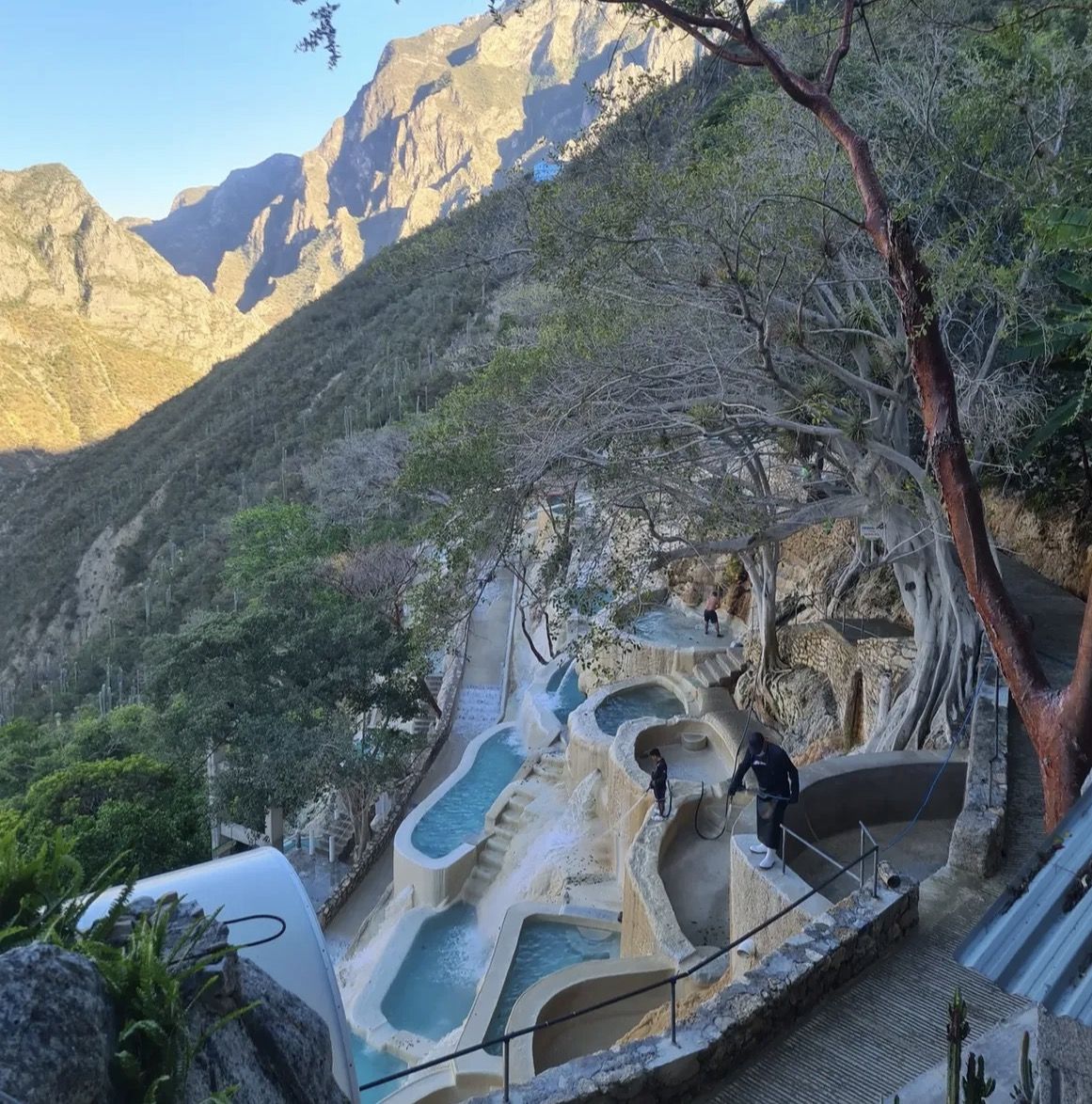
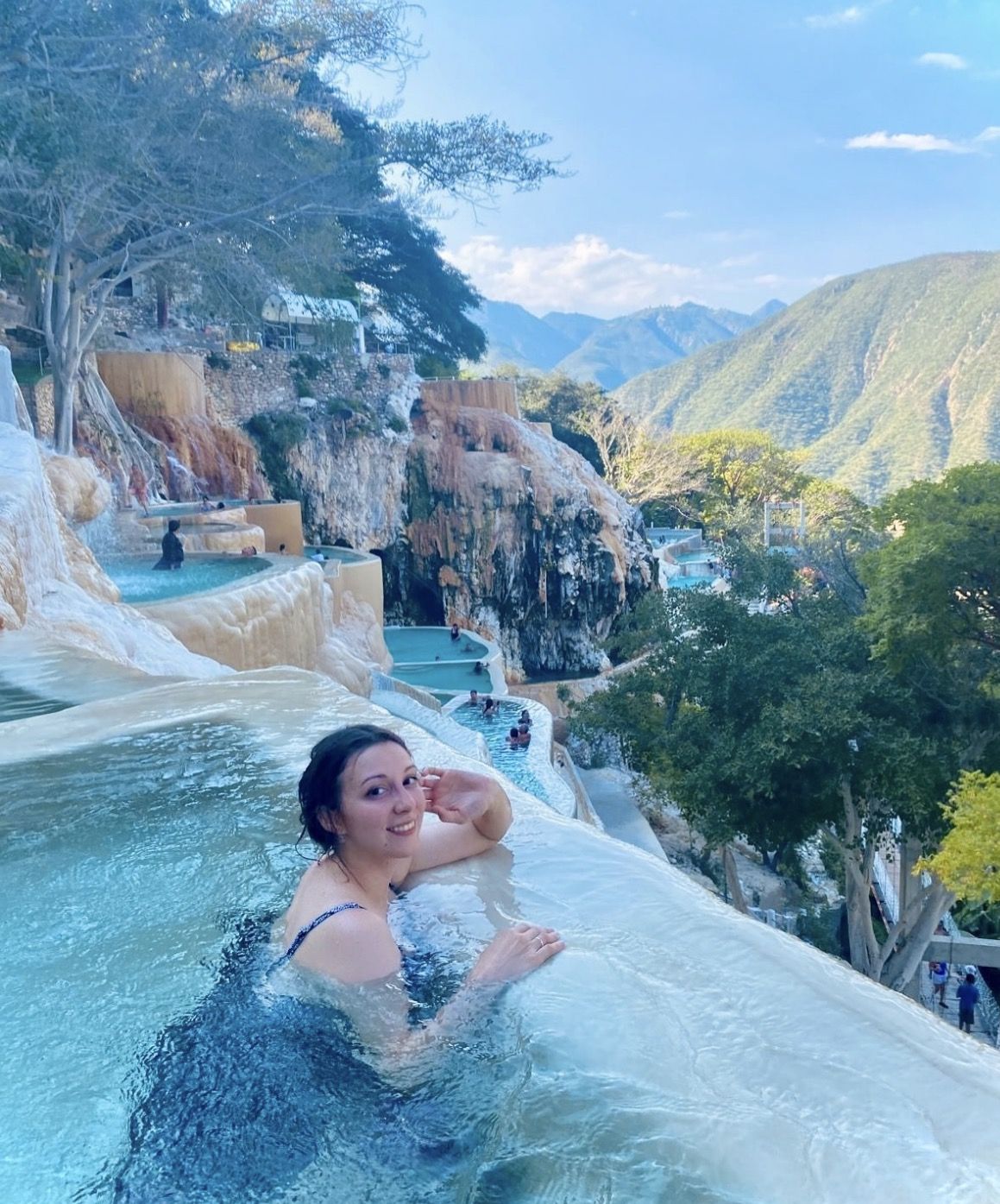
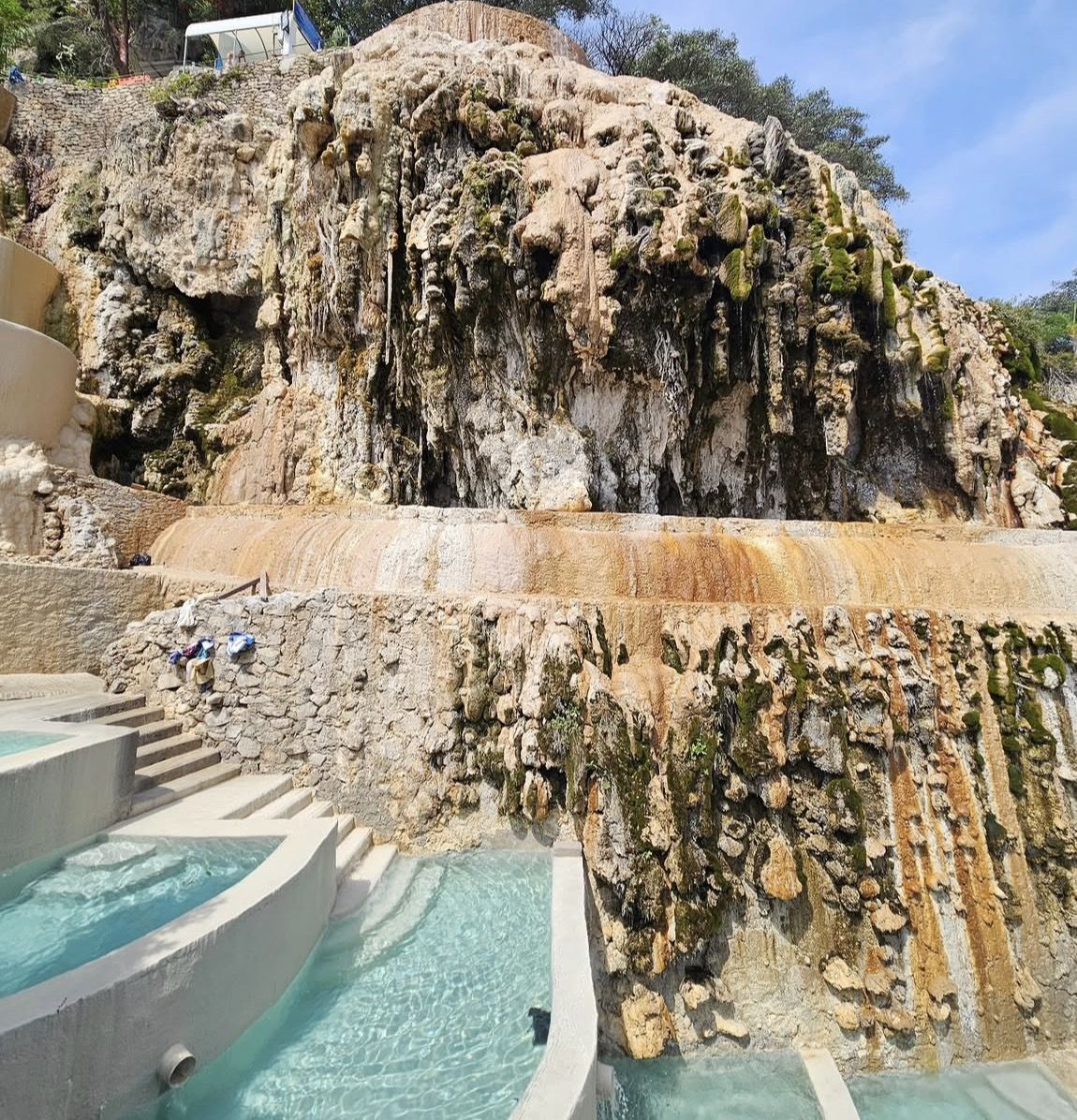
In shortHidalgo's thermal water rises from aquifers in Cretaceous limestone under the Mezquital valley, which sits at 1,700 to 2,100 metres inside the Trans-Mexican Volcanic Belt. Balnearios line the México–Laredo highway at Ixmiquilpan and Tasquillo. Grutas Tolantongo is the one with the scenery: a box canyon at 1,280 metres with walls up to 500 metres, about 40 cliff pools and water at 36–38 °C.
1,700–2,100 mMezquital valley altitude
36–38 °CTolantongo pool temperature
117 kmPachuca to the canyon
from $13713-hour tour from the capital
Where Hidalgo's thermal water comes from
The pools between Ajacuba and Tasquillo all draw on the same ground. Under the Valle del Mezquital, which lies between 1,700 and 2,100 metres inside the Trans-Mexican Volcanic Belt, researchers have identified three overlapping aquifers; the deepest sits in Cretaceous limestones, and that is the reservoir feeding the region's springs. The clustering of balnearios here, rather than in the states next door, follows from that geology.
Tolantongo is where you can watch the system work. From its head north-west of Cardonal at roughly 2,300 metres, the Barranca de Tolantongo drops to about 1,150 metres by Itztacapa, cutting into Upper Cretaceous limestone interleaved with shale that tilts at 30 degrees or more, with early Tertiary piedmont material on top in which limestone blocks reach three metres. The water appears inside the mountain at about 37 °C, the warmest reading on the site, and goes tepid where it mixes with the cold river beyond the grottoes.
The river itself belongs to the Pánuco hydrological region, Moctezuma basin and Amajac sub-basin. Its turquoise cast is widely put down to calcium and magnesium carried in the mineral water, which is also why the colour shifts as soon as mountain rain loads the river with silt.
The resorts strung along the highway north of Pachuca
Drive north from the state capital and the thermal parks arrive in a line, most of them within a few hundred metres of the old México–Laredo road. They are family water parks for the most part: wave pools, slides, concrete terraces, a restaurant, picnic tables. Two sit at Ixmiquilpan, the service town where the Tolantongo turn-off is, and a third is 10 km further at Tasquillo.
Prices and opening hours below come from each operator's own pages. Check them the day before you set out, since several of these parks change weekday and weekend rates.
- Parque Acuático El Tephé, Carretera México–Laredo km 152 at Ixmiquilpan: open 8:00 to 20:00 daily, MXN 150 Monday to Friday, MXN 170 at weekends and on holidays, MXN 85 with an INSEN card, children under one metre free.
- Parque Acuático Dios Padre, four highway kilometres further along at km 156: the one in this group that never shuts, 6:00 to 20:00 on all 365 days, MXN 220 general with a MXN 160 Monday-to-Friday rate; its eight named attractions include the Playa Sirena wave pool, the Kraken slide, a slide tower and the Isla Pirata zone for children.
- Hotel Balneario Tzindejéh, km 170 at Tasquillo: 9:00 to 18:00 daily, MXN 120 to 140 for adults, MXN 90 for children aged 3 to 11 and INAPAM holders; springs at a constant 31 °C, three pools and a kiddie pool, three open-air and two covered thermal pools, 25 rooms.
- Xhandos Ajacuba, about 1 hour from Pachuca and 1 hour 30 minutes from Mexico City: MXN 140 general, MXN 100 for children 3 to 11, MXN 80 with an INAPAM card, pools averaging 36 °C.
- Parque Acuático Amajac sits off the highway corridor at Atotonilco el Grande, roughly 45 minutes out of Pachuca, charging MXN 170 for adults and MXN 130 for children aged 6 to 12.
- Grutas Tolantongo, San Cristóbal in the Municipio de Cardonal: the turn is at Ixmiquilpan, with 42.9 km and about 1 hour 11 minutes of mountain road after it.
Thermal springs in Hidalgo compared on setting, travel and water
People searching for Hidalgo Mexico hot springs usually end up with five or six names on a list and no way to tell them apart. The useful division is between the roadside water parks, which you reach in under two hours from Pachuca and leave the same afternoon, and the canyon sites at Cardonal, which take most of a day and look nothing like the others.
Figures below are each operator's own. Where a published travel time does not exist, the geography is given instead.
| Thermal site | Setting | Travel | Admission | Type of day |
|---|
| Grutas Tolantongo, Cardonal | Floor of a box canyon at 1,280 m, walls up to 500 m | 117 km and about 2 h 28 min from Pachuca; 201 km and about 3 h 50 min from Mexico City | MXN 230 a head, billed again for each day you enter, cash in hand | About 40 cliff terrace pools at 36–38 °C, a grotto, a tunnel, waterfalls and a thermal river |
|---|
| La Gloria Tolantongo, La Mesa ejido | Same canyon, a separate community with its own gate | Its own site quotes 3 h 20 min out of Mexico City and 4 h from Puebla | Adults MXN 180, children on the adult rate from their sixth birthday, gate open 7:00 to 19:00 | Water out of the ground at 38 °C, family pools, the Cola de Caballo falls and the Baño del Licenciado dropping more than 30 m |
|---|
| Xhandos Ajacuba | Open valley south-west of Pachuca | About 1 h from Pachuca, 1 h 30 min from Mexico City | General MXN 140; ages 3 to 11 MXN 100; INAPAM holders MXN 80 | Pools averaging 36 °C, the easiest thermal soak to reach from either city |
|---|
| Parque Acuático Amajac, Atotonilco el Grande | East of the valley, in the hills above Pachuca | About 45 minutes from Pachuca | MXN 170 adults, MXN 130 children 6–12 | Straightforward family water park |
|---|
| Dios Padre, Ixmiquilpan | Beside the México–Laredo highway at km 156 | Ixmiquilpan is about 1 h 38 min direct by bus from Pachuca, MXN 42–61 one way | MXN 220 general, MXN 160 Monday to Friday, open 6:00 to 20:00 every day of the year | Slides and a wave pool, including Playa Sirena, the Kraken and Isla Pirata |
|---|
| El Tephé, Ixmiquilpan | Same corridor, km 152 | In Ixmiquilpan, 42.9 km short of Tolantongo | MXN 150 Monday to Friday, MXN 170 weekends and holidays, 8:00 to 20:00 | Large municipal-style thermal water park, cheapest of the Ixmiquilpan pair midweek |
|---|
| Tzindejéh, Tasquillo | km 170, about 10 km beyond Ixmiquilpan | On the same highway, before the Zimapán stretch | Adults MXN 120 to 140; MXN 90 for ages 3 to 11 and INAPAM cards; 9:00 to 18:00 | Springs at a constant 31 °C, five thermal pools plus three swimming pools and a kiddie pool, 25 rooms on site |
|---|
Why Tolantongo is the one to cross the state for
The other sites on that list are pool complexes with a car park at the gate. At Tolantongo you drive down into the canyon itself. Floor level is 1,280 metres, and the limestone sides stand as much as 500 metres over the water, so the terraces move in and out of shade through the day and the air beside the pools stays mild in January.
What no balneario on the highway has is the terrace bank: somewhere around 40 pools stacked one above the next up a cliff face, every one fed on its own line of pipe from the spring cave near the top of the canyon, with the whole network emptied and cleaned every second day. For the cave, the tunnel and those terraces the park's pools page states 36–38 °C. For the river the same operator publishes two numbers, 34–36 °C on its English page and 36–38 °C on its Spanish one, so treat either as approximate.
The grotto puts the place in a different category from a pool complex altogether: a chamber about half a tennis court in area, up to ten metres of rock overhead, hot water falling out of the ceiling in a steady shower. The land is held by the Sociedad Cooperativa Ejidal 'Grutas Tolantongo', 112 families with roughly 5,200 hectares between them, of which only some 40 are opened to visitors.
One thing to get straight before you go. The canyon holds two separate operations: Grutas Tolantongo, run by the San Cristóbal ejido, and La Gloria, run by the neighbouring La Mesa ejido, which sells its own ticket at MXN 180 for adults and does not appear on the Grutas internal shuttle list. Pick one for the day unless your itinerary covers both.
In the canyon when the pools open
Thirteen hours from the capital with admission and an air-conditioned vehicle covered, built around a 4:30 am meet so you reach the terrace pools and the grotto before the day fills.
★ 4.9/5 · 679 reviews
Getting across Hidalgo to the canyon
The reason this trip defeats people is the clock rather than the distance. Per the official site, 17:00 is the end of the day for the caves, the tunnel, the waterfalls and the swimming pools, all of which start at 8:00; only the thermal river and part of the terrace bank carry on to 21:00. Arrive at midday and you have cut the best of it in half. The operator's own table allows 3 hours 50 minutes for the 201 km from Mexico City, 2 hours 28 minutes for the 117 km from Pachuca and 1 hour 11 minutes for the last 42.9 km from Ixmiquilpan, which drops more than a kilometre into the barranca on tight bends.
Add the cash problem. Tickets, hotels, the restaurant, the shop and the shuttles are all paid in cash, cards are accepted nowhere inside the park, and the nearest ATM is back in Ixmiquilpan an hour away. The gate price is MXN 230 a head, applied day by day, and it is good only on the day you buy it.
For the Hidalgo Mexico hot springs that are worth the drive, a departure that carries the transport and the ticket is the cleanest way to do it in one day. The Early & Express Tolantongo Hot Springs runs 13 hours with park tickets and an air-conditioned vehicle in the price, from $137, rated 4.9 across 679 reviews, with a meeting time by 4:30 am precisely so you are on the cliff terraces when they open. Lunch is not included.
A professional guide walks the sections with you on the Tolantongo Caves Hot Springs & Waterfalls Small Group Tour, which also covers entrance to the caves and round-trip transport: 14 hours, from $132, rated 4.6 from 351 reviews, water not supplied and the box lunch only if you select that option. Licensed operators run both, and on either one a cancellation made 24 hours or more ahead of departure is refunded in full. Drivers who already have a car and a pre-dawn start follow the México–Pachuca highway, then the Actopan–Ixmiquilpan road, turning right at Ixmiquilpan onto the Libramiento a Cardonal; tolls come to roughly MXN 127 on the CAPUFE route and parking is MXN 50 per vehicle per day, space only, with no custody or liability accepted.
When to go, and which days to avoid
The heat is geothermal, so the season does not change the water. What changes is the air and the river. Average highs at Ixmiquilpan run 23 °C in January, 27 °C in March, 28 °C in April and May and 23 °C in December, with overnight lows around 8 °C in January and December and about 16 °C in June. Cool dry mornings make 36–38 °C water feel far better than a hot afternoon does, which is why late October to early December and February to April are the windows to aim for.
Rain is the real argument against summer. Ixmiquilpan's wet months, about 4.4 of them, run from 1 June to 12 October, and monthly rainfall climbs from roughly 9 mm in December to around 137 mm in September; the park puts its own rainy stretch at mid-June to mid-July and tells campers to keep off the riverbank through it. Heavy mountain rain lifts the river fast and muddies the turquoise. That is what happened in July 2021: tents were shifted to higher ground and the grottoes were roped off. During those months the park's line is to stay away from the river and do whatever security staff tell you.
Occupancy, as described by one of the park's co-owners, sits at 20 to 30 per cent on an ordinary weekend, climbs to about 75 per cent over long holiday weekends and reaches 100 per cent on the main days of Semana Santa. Midweek in the dry season the same cliff pools are close to empty. The park operates every day of the year from 7 am to 8 pm, so book a Tuesday rather than a Saturday if your dates allow it.
Questions people ask
Is the water at Tolantongo hotter than at the other Hidalgo balnearios?
It is at the warmer end of the range. The spring inside the mountain at Tolantongo is reported at about 37 °C and the park gives its cave, tunnel and terrace pools as 36–38 °C, while La Gloria next door says its water emerges at 38 °C. For comparison, Xhandos Ajacuba lists pools averaging 36 °C and Tzindejéh at Tasquillo describes springs at a constant 31 °C.
Are Grutas Tolantongo and La Gloria the same place?
No. They share the canyon but belong to different communities, Grutas Tolantongo to the San Cristóbal ejido and La Gloria to the La Mesa ejido, and each charges its own admission. At La Gloria an adult pays MXN 180, children pay that same rate once they turn 6, anyone walking in over the Puente de Tolantongo pays MXN 150, and the gate works from 7:00 to 19:00. La Gloria is also absent from the Grutas shuttle price list, which stops at La Gruta, La Cadena, La Huerta, Rancho and Paraíso, so work out the crossing yourself.
Do the Hidalgo thermal parks take cards?
Assume not at Tolantongo. Every payment inside Grutas Tolantongo is cash, including tickets, rooms, the restaurant, the shop, lockers and the shuttles, and there is no ATM at or near the park. The closest cash machines are in Ixmiquilpan, 42.9 km and about 1 hour 11 minutes away, so draw your money there before the descent and carry small notes.
Do children and seniors pay less at Tolantongo?
Children aged 0 to 4 enter free and the full adult ticket applies from the fifth birthday. Seniors with a valid INAPAM credential get 50 per cent off admission. At the highway balnearios the structures differ: El Tephé lists MXN 85 with an INSEN card and free entry for children under one metre, while Xhandos charges MXN 100 for children aged 3 to 11 and MXN 80 with INAPAM.
Can I pair the Basaltic Prisms or Grutas Xoxafí with a thermal day?
Not the Prismas, at least not on the same day as Tolantongo: they are 111 km and about 2 hours 31 minutes apart, each at the end of its own mountain road, and from Mexico City the Prismas are a separate 120 km trip of roughly 1 hour 42 minutes, with admission MXN 100 and opening 8:00 to 19:00. Grutas Xoxafí at El Palmar, Santiago de Anaya, is about an hour from Pachuca and opens 9:00 to 17:00 daily with caving, rappels of up to 44 m and a zipline over 300 m, so give it a day of its own.
Read also